
On aquifers, chlorine, broken pipes and the system nobody is looking at whole.
Stand on the shore at Ibiza after heavy rain. The sea is brown. Not murky from sediment stirred up by waves, but stained from the land itself: the soil, the chemicals, the runoff that raced off roads and rooftops and compacted gardens, across every sealed surface that no longer knows how to absorb, straight into the water. It contains, in one visible image, much of what is wrong with how this island relates to water.
Gustavo Fraile Reynoso, is an architect at Naturaleza y Arte in Ibiza. He puts it with the precision of someone who has watched this process up close for a long time: “Anyone who has looked at the sea these past days after heavy rain could see it. That brown water is wasted rainfall, not infiltrated into the aquifers. And the biggest reservoir we have is right beneath our feet.”
This is the central paradox of water on Ibiza. The island is ringed by ocean, and rain falls on it. Yet according to the Alliance for Water, thirteen of the island’s sixteen groundwater bodies are in poor condition, because they are overexploited, salinized, or both. Ses Feixes in Vila, once the vegetable garden of the town, irrigated by a hydraulic system that dates back to Moorish times, lost its supply of fresh water as the surrounding land was built over and the aquifer that fed it became salinized. Meanwhile the island keeps building.
The crisis is documented. What is less understood is that it is not one crisis. It is a system of interconnected decisions, each making the others worse
The Loop
Every sealed surface in a town or development sheds water instead of absorbing it. When rain falls on Ibiza Town or Sant Antoni, it runs, carrying with it whatever lay on those surfaces. In the countryside, too, heavy rain reaches the sea faster than the land can absorb it, and erosion leaves the water no time to sink into the soil. The aquifers below, which filled slowly through exactly this kind of gentle infiltration, receive less. As they are pumped down along the coast, the pressure that kept seawater out weakens, and saltwater intrudes. Wells that were fresh become brackish. Desalination is expanded to compensate. The brine that desalination leaves behind returns to the sea, where Posidonia meadows depend on a stable salinity to survive. The meadows that produce oxygen, filter the water and give the sea its clarity, the clarity the island’s economy is built on, come under pressure.
This is not a chain of isolated problems. It is one problem wearing different faces.
Elsewhere in the same system, a conventional pool is filled, chlorinated, maintained. Stefan Meier, a landscape architect who builds natural swimming pools and aquatic ecosystems through theBIOPOOL, traces what happens to the chemicals. “Chlorine is a volatile gas that reaches the upper layers of the atmosphere and attacks the ozone layer,” he explains. “In the water, biological compounds such as leaves, skin and urine react with the chlorine to form various chloramines, which are considered carcinogenic. Some evaporate and cause childhood asthma. The rest accumulates in the bathing water.” The pool has to be partially drained from time to time. That water, chemically loaded and often saline from electrolysis systems, has to go somewhere. On Ibiza, Stefan says, he has not seen a single case where it is properly treated before disposal. It ends up on the street, on the land, or in the sewage system.
The sewage system is under pressure of its own. The Alliance for Water’s 2025 report found that all eleven wastewater treatment plants on Ibiza received incoming wastewater outside legal limits in at least one month of the year, the worst record of the four Balearic islands. About 40 percent of the island’s incoming flow was affected. And 97.9 percent of the incoming volume exceeded the salinity threshold, the highest value in the Balearics, with no improvement in five years. The Alliance identifies seawater seeping into the aging sewer network as the underlying cause, and the brine discharged by private desalination plants adds to it. Salt of this kind cannot be removed by conventional treatment, and it is the reason the treated water cannot simply be reused for irrigation.
There is good news in the same report, and it deserves to be said. The new Sa Coma plant, which replaced the old Vila plant, now treats almost half of the island’s flow and meets the legal criteria in full. The Alliance also notes that the improvement came almost twenty years late: the works were tendered in 2015 and only finished in 2024.
Meanwhile, according to the Alliance for Water, more than four million cubic metres of water were lost in 2024 through leaks in the municipal distribution networks of Ibiza. That is comparable to the entire annual output of the Vila desalination plant, and, by the Alliance’s calculation, to the yearly consumption of 94,000 people.
What Desalination Cannot Solve
Desalination is often presented as the answer to Ibiza’s water problem. Gustavo is careful but direct: “In the short term, yes, if we do not question our socioeconomic model. But in the medium term they are clearly a patch of extremely high energy consumption that allows the perpetuation of a model already defined as unsustainable.” Building expensive, energy-intensive plants while a comparable volume disappears through leaking pipes is a way of deferring a decision.
The deeper question Gustavo raises is structural. The geographer Leandro del Moral has proposed understanding water as the fundamental resource on which a territory’s socioeconomic model rests. On Ibiza, as long as that model depends on mass tourism, it is the aquifers, the desalination plants and the sewage facilities that make it possible or impossible. Local residents who save water, restore their land and invest in infiltration are, in effect, replenishing a resource that the tourism economy will draw on the following summer. “Any effort by the local population to restore the aquifers in winter will, in practice, simply deliver that basic resource on a silver platter to a model that, paradoxically, destroys the very thing that allows it to exist,” Gustavo says. It is not a counsel of despair. It is a demand for a more honest conversation about what the island is for and who its water belongs to.
The Hydrological Plan of the Balearic Islands, approved in 2023, sets out the works the islands need. According to the Alliance for Water, only 23 percent of them have been set in motion so far. A plan on paper does not slow the water down.
t
Nature Already Knows
What makes this more than a story of negligence is that the solutions are not theoretical. They exist, they work, and they are being built on the island right now.
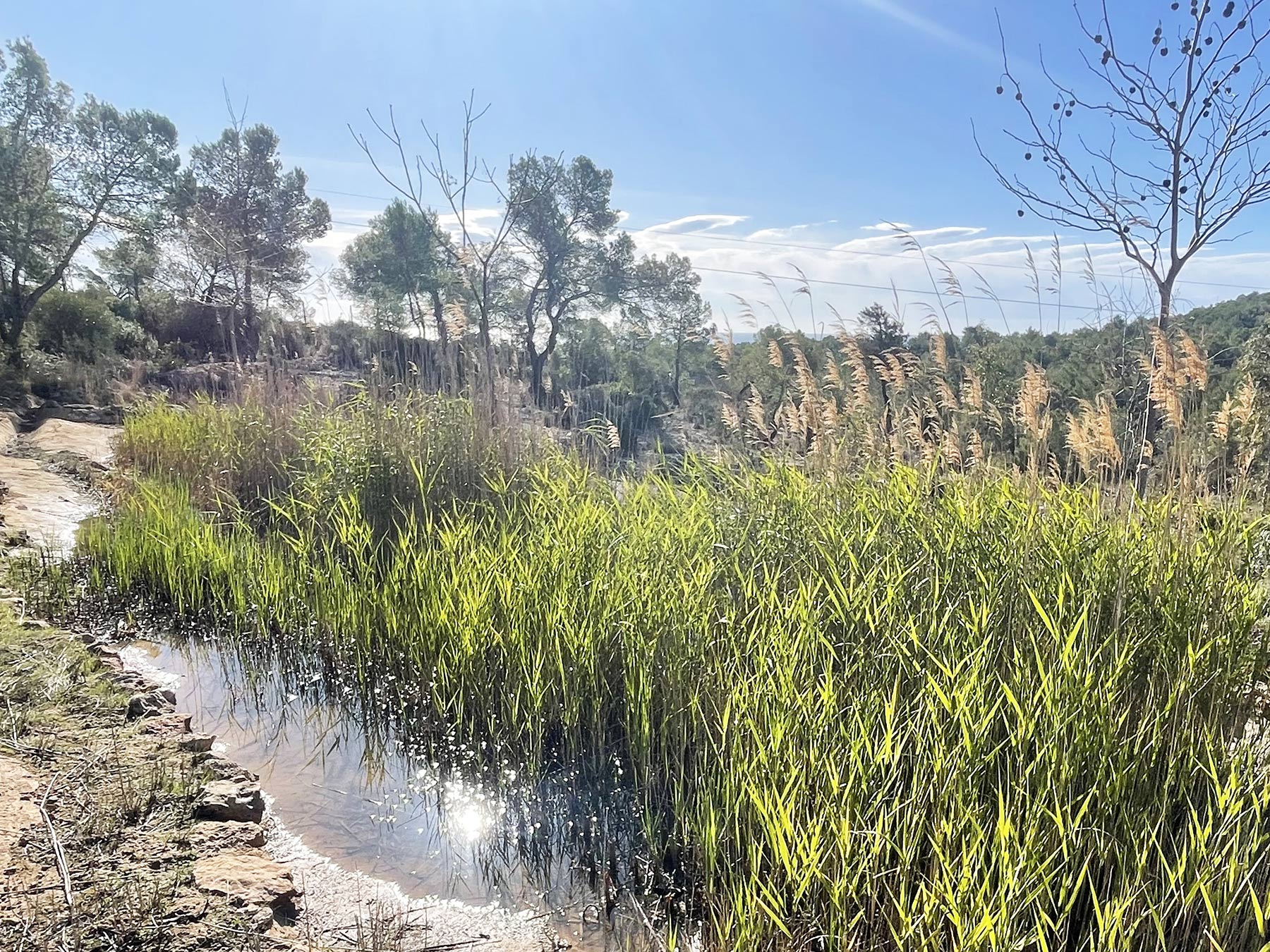
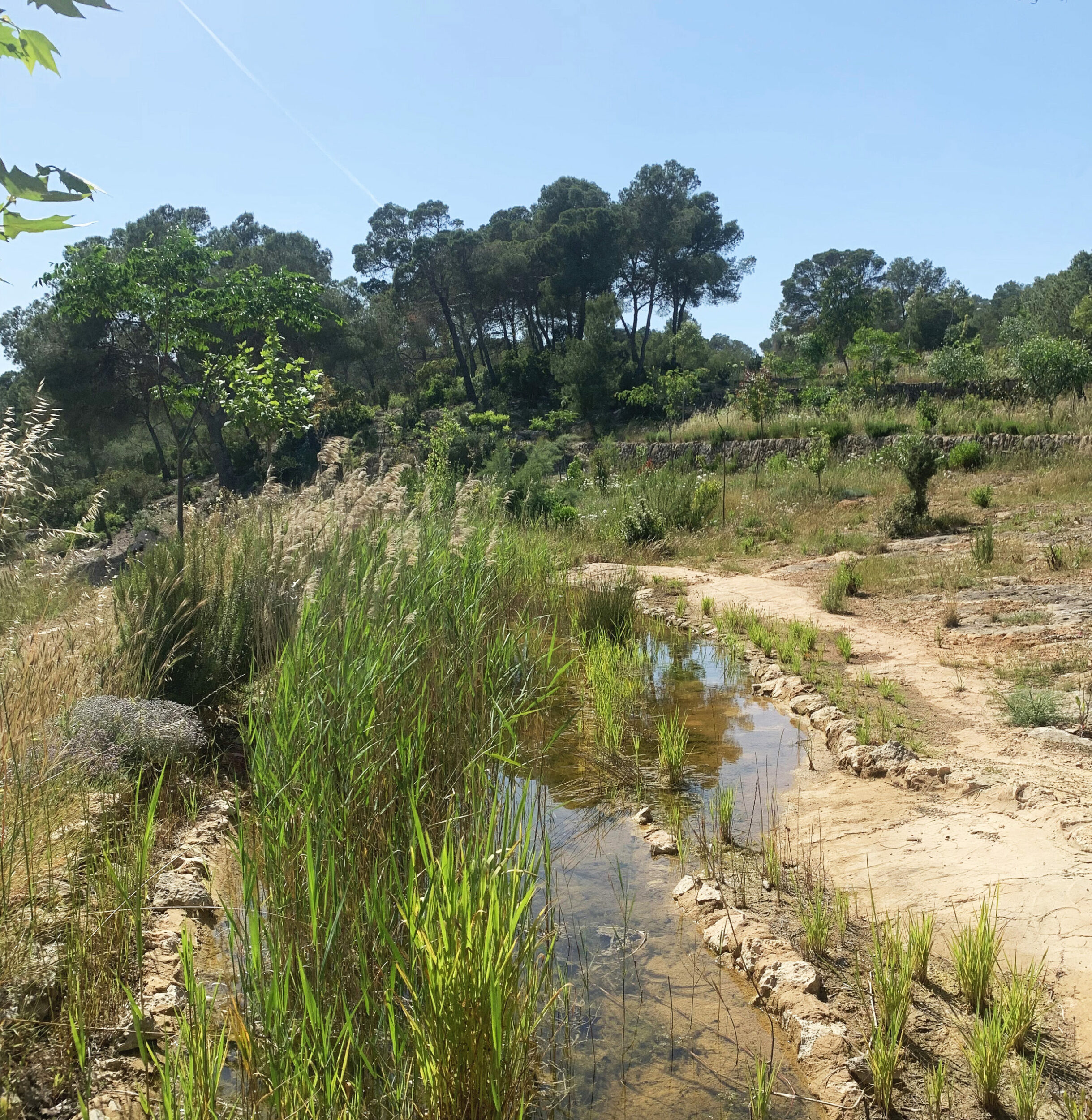
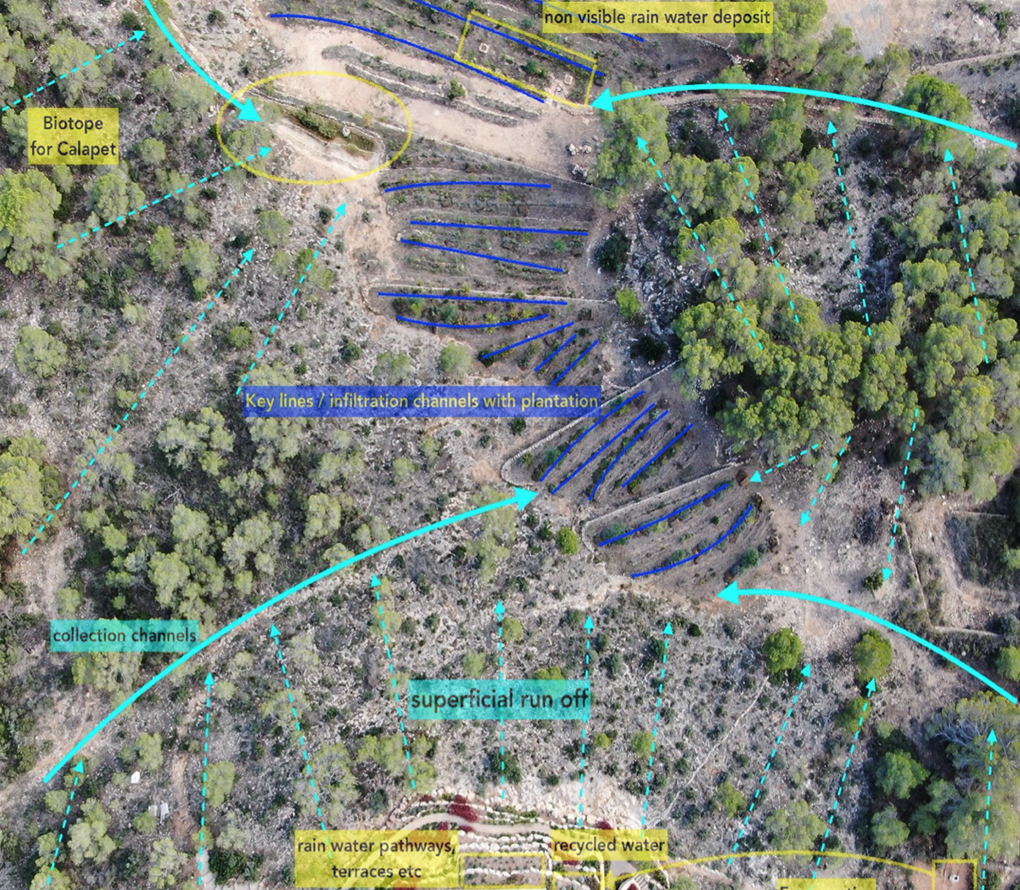
The pilot project for integrated rainwater management by Stefan Meier with Naturaleza y Arte combines several techniques to slow the water, let it sink, and return it to the aquifer rather than the sea. It is called a pilot not because the approach is experimental, but because monitoring reports were set up to evaluate its results, in a setting where local regulation has not yet caught up with what ecology and hydrology have long shown. “Experience and action go ahead of regulation and, unfortunately, not the other way around,” says Gustavo. What he wants most is expressed in the motto of the Alliance for Water: not a single drop to the sea.
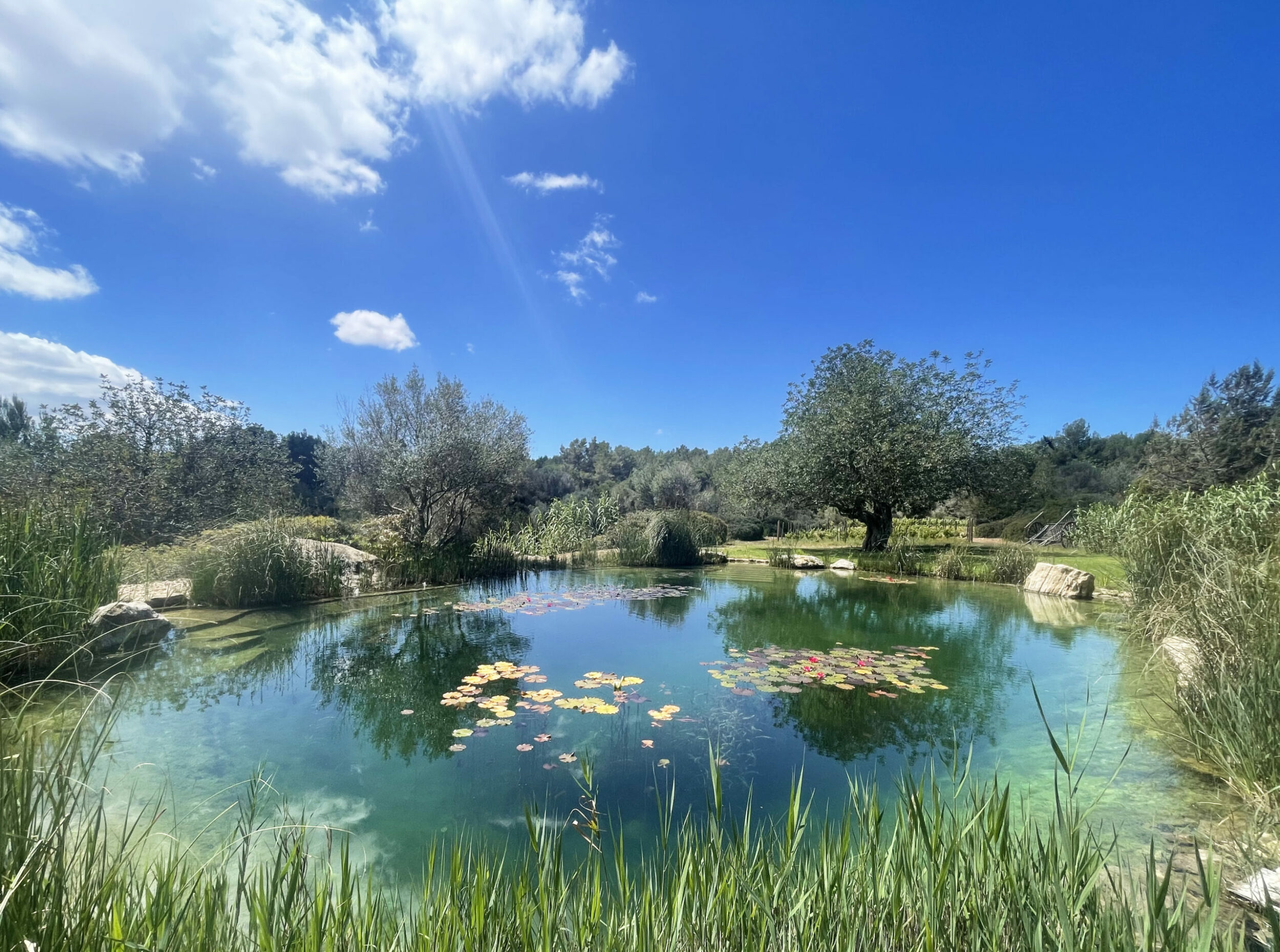
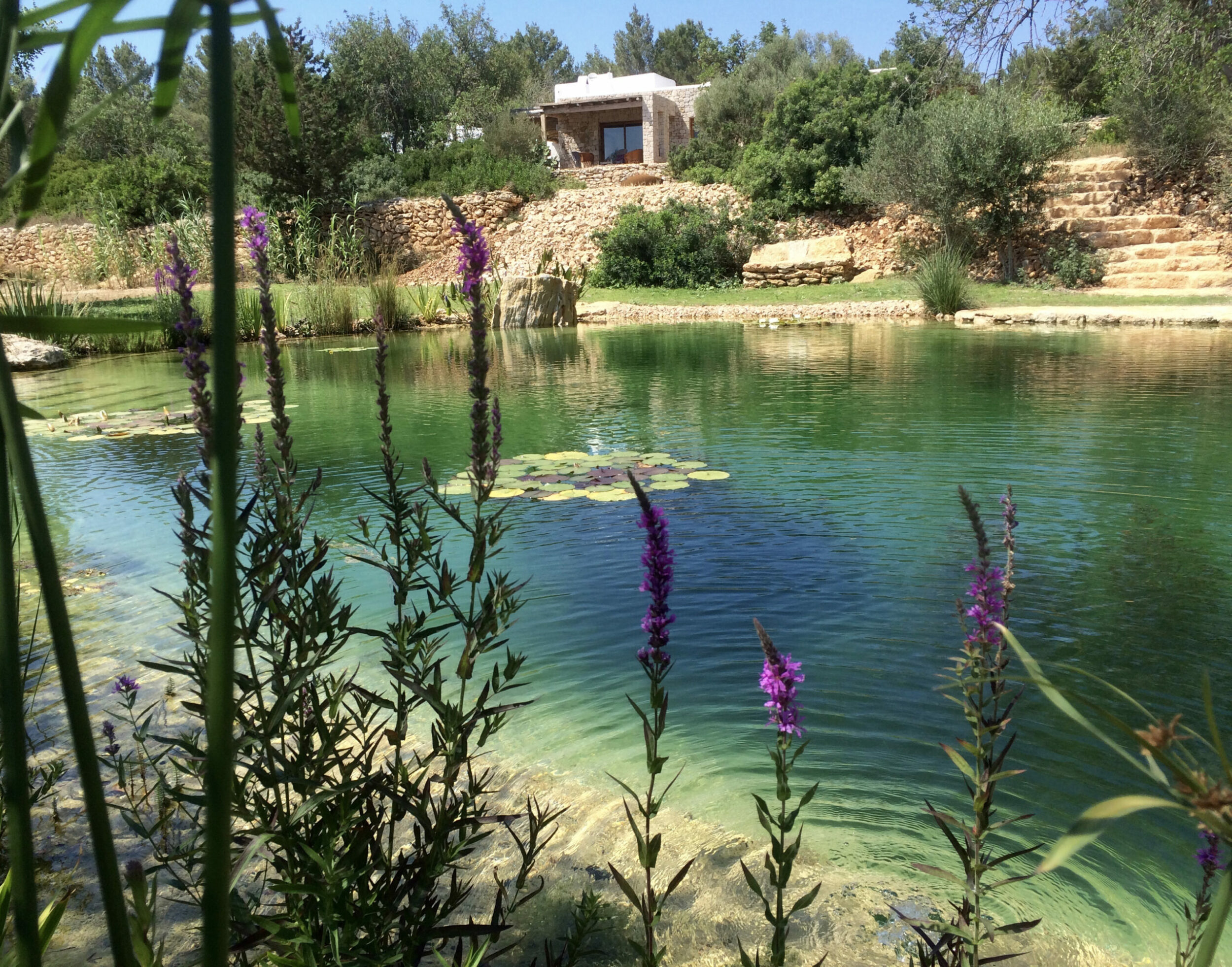
The same logic applies at the scale of a single property. Stefan’s natural pools work on biological principles close to those that keep the Mediterranean clear. Plants in the pool, Posidonia in the sea: both take up nutrients, produce oxygen and keep water clean without chemicals. A natural pool produces no chemical waste, and its cleaning water is uncontaminated enough to irrigate a garden. What returns in terms of life is striking in projects across the island: dragonflies, the locally rare Balearic tree frog, bats, genets, bees. “Biotopes at the water-land intersection are typically the most species-rich, genuine biodiversity hotspots,” Stefan says. “Nature shows us how. And only if we understand it well can we copy and rebuild it.”
The scientific literature on the Mediterranean points in the same direction. A study of the Los Arenales aquifer in Spain compared an area with managed aquifer recharge to one without, and found that deliberately replenishing groundwater measurably raised water levels and softened the effects of drought. A risk assessment of recharge projects across the Mediterranean found that legal, social and economic factors matter more for failure than technical ones. The island has the geology, the rainfall and the expertise. What it needs is the collective decision to use them differently.
Research on wildfire adds a dimension that is rarely connected to water. A 2017 study in Nature Climate Change, carried out in the humid tropics, found that hydrological drought, meaning depleted water stores and not just missing rain, substantially increased the area burned. Ibiza’s climate is different, and the result cannot simply be transferred, but it points at a link worth taking seriously: dry groundwater and dry landscapes are not separate problems.
Cities That Absorb Water
One piece of the picture rarely appears in discussions of Ibiza’s water future: urban drainage. Sustainable urban drainage systems rethink how a town deals with rain. Instead of evacuating it as quickly as possible, they slow it, filter it and return it to the ground, through permeable surfaces, infiltration trenches, retention ponds and constructed wetlands. Applied to the island’s towns and developments, these techniques could turn what now rushes to the sea into water that replenishes the aquifers beneath the streets. The streets flood while the aquifers stay empty. The same infrastructure decision shapes both.
What Children Already Know
This is why Creatives for the Planet brings water into every workshop it runs with children across the island, whether the subject is the water cycle itself, the Posidonia meadows that filter the sea, or the traditional knowledge of Ibiza’s rural women in the Tornem a la Terra film series. The women in those films never called what they did sustainability. They called it life. They lived from what the land gave them and wasted little. They understood, without needing a framework for it, that nothing functions without water, and that water functions only if the land around it is tended. What children grasp quickly in these workshops is the same thing: that the sea they swim in, the rain that falls, the ground beneath their feet and the tap they drink from are one continuous system.
What Each of Us Can Do
As we learned from Silvano Rizzi, an expert in water retention, during the workshops held at Terra Viva, the most important thing is to apply the “three S’s”: slow down, spread and sink. Understanding the water cycle and restoring it is a simple solution.
He taught us that it makes sense to start in the highest parts of the land, where rainwater can be held back before it causes erosion. Small interventions that slow the water down and help it filter into the ground, such as mulching, containment barriers and furrows, can be made with nothing more than the materials already found on the land itself: cut branches, fallen logs or shrubs.
Another thing we can do is keep the surface of the soil covered with vegetation, because it allows the water to soak in better and keeps organic matter from being washed away by erosion. In Silvano’s words: “In our culture, when we see lakes, we see water; we see abundance and security. But we must remember that water is also green: it is present in the vegetation and beneath the surface of the earth, in the aquifers.”
A Different Question
To love this island, as so many people genuinely do, is to love what sustains it. The Posidonia that filters the sea, the aquifer that holds the rain, the wetlands that slow the water down: these are not background scenery. They are the infrastructure that makes everything else possible.
The solutions do not require waiting for policy. A garden with native plants needs less water and returns more water to the soil. A natural pool creates a habitat instead of depleting one. A roof connected to a cistern captures what would otherwise be lost. A permeable surface lets the rain sink. These are not sacrifices. They follow from understanding what water is on this island: not a commodity to be extracted and discharged, but the living substance that connects everything.
It ends with the clearest instruction: slow the water down. Give it time to sink. The reservoir is already there. We built our lives above it, and we are draining it, one sealed surface, one chlorinated pool, one broken pipe at a time. The question is not whether we can change this. The question is whether we will decide to.
Text: Sophia Brucklacher
Images: https://naturalezayarte.com/
Sources
Alliance for Water / Aliança per l’Aigua
Annual report on sanitation and treatment, 2025, presented in the Observatorio del Agua de Baleares (September 2026), as reported by La Voz de Ibiza (“Ibiza tiene el agua residual más contaminada de Baleares”) and Noudiari (“El 98% del agua que llega a las depuradoras de Ibiza es salada y acaba contaminando la costa”, 4 September 2026)
Report on water losses in Ibiza’s distribution networks (September 2025), as reported by Periódico de Ibiza (22 September 2025) and La Voz de Ibiza
“Only 23% of the works of the Hydrological Plan of the Balearic Islands have been set in motion” (alianzaagua.org)
“Ses Feixes: a unique green area awaiting environmental recovery”, Juan Calvo (alianzaagua.org)
“Ibiza en riesgo de desertificación: denuncian 13 de 16 acuíferos en mal estado”, La Voz de Ibiza
Legal basis
Real Decreto 49/2023, of 24 January, approving the Hydrological Plan of the Hydrographic Demarcation of the Balearic Islands (BOE)
Scientific literature
Henao Casas, J.D., Fernández Escalante, E., Ayuga, F. (2022). “Alleviating drought and water scarcity in the Mediterranean region through managed aquifer recharge.” Hydrogeology Journal. doi.org/10.1007/s10040-022-02513-5
Rodríguez-Escales, P. et al. (2018). “A risk assessment methodology to evaluate the risk failure of managed aquifer recharge in the Mediterranean Basin.” Hydrology and Earth System Sciences, 22, 3213-3227. doi.org/10.5194/hess-22-3213-2018
Taufik, M. et al. (2017). “Amplification of wildfire area burnt by hydrological drought in the humid tropics.” Nature Climate Change. doi.org/10.1038/NCLIMATE3280
Pool, M. and Carrera, J. (2011). “A correction factor to account for mixing in Ghyben-Herzberg and critical pumping rate approximations of seawater intrusion in coastal aquifers.” Water Resources Research.
Instituto Geológico y Minero de España (IGME). “Hydrogeological systems of the Balearic Islands.” Las aguas subterráneas en España, Chapter 18.
Castro Fresno, D. et al. (2005). “Sistemas urbanos de drenaje sostenible (SUDS).” Interciencia, 30(5), 255-260.
Expert interviews (October 2026) and workshops
Gustavo Fraile Reynoso (Gus), architect, Naturaleza y Arte, Ibiza
Stefan Meier, landscape architect, founder of theBIOPOOL, Cala Vadella, Ibiza
Silvano Rizzi, water retention expert, as taught in workshops at Terra Viva