There’s a phrase that sounds almost like a contradiction: the cleanest waste. But spend a few minutes understanding what actually happens to organic waste on Ibiza, and it starts to make perfect sense.
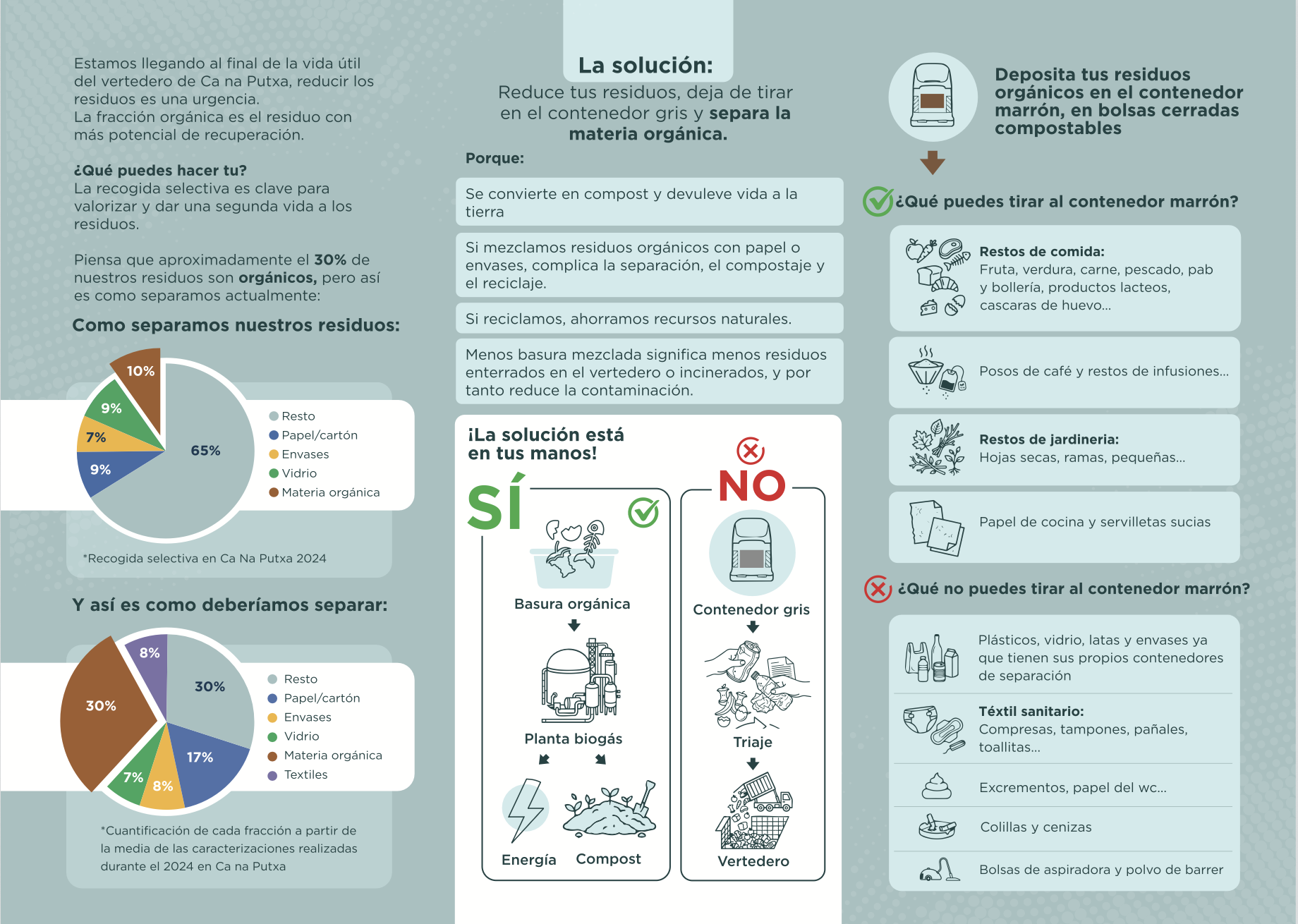
Organic matter – kitchen scraps, vegetable peels, leftover food, coffee grounds – makes up roughly 40 percent of everything we throw away. Of that 40 percent, only 10 percent is currently being collected separately in the brown bin. The rest ends up mixed into general waste, and although it gets sorted at the treatment plant, good quality compost can’t be obtained. The gap between what we could be doing and what we’re actually doing is enormous – and it’s in our hands to close the circle.
It’s the single largest category of waste we produce, and almost nobody talks about it. The conversation is always about plastic, packaging, the visible tide of consumption. Meanwhile, the banana peel quietly goes into the grey bin and separating it from there generates far more work than most people realise.
Here’s what most residents and visitors don’t know: when organic waste is separated correctly and collected in the brown bin, it enters a careful sorting process before being transformed – at Ca Na Putxa, Ibiza’s treatment facility – into compost that returns nutrients directly to agricultural land, and biogas that generates electricity. A closed loop. And here’s why it qualifies as clean: unlike plastic or mixed waste, organic matter processed this way leaves no toxic residue, no microplastics, no landfill legacy. A bag of kitchen scraps goes in and comes out as soil and energy. That’s why it earns the name.
The case for getting this right becomes even harder to ignore when you learn one more fact: organic waste is roughly 80 percent water by weight. When it ends up contaminated with plastics or packaging, it loses quality, complicates the entire process, and puts pressure on a landfill that already has limited capacity. The brown bin gives it room to breathe.
The solution doesn’t require new infrastructure or political decisions – the solution is in your hands. Start by reducing what you generate, then separate correctly what you consume. On Ibiza, many families have always composted at home or fed scraps to animals. That tradition is still the best option where possible. For everyone else, the brown bin is the next best thing.
What belongs in the brown bin: fruit and vegetable scraps, cooked food, meat, fish, bread, dairy, eggshells, coffee grounds and filters, teabags, paper napkins… What doesn’t: plastics, glass, liquids, cigarette butts or cooking oil (which has its own separate collection)… Even small amounts of the wrong material compromise the entire system – which is why what each person does at home directly determines the quality of the compost the island can recover.
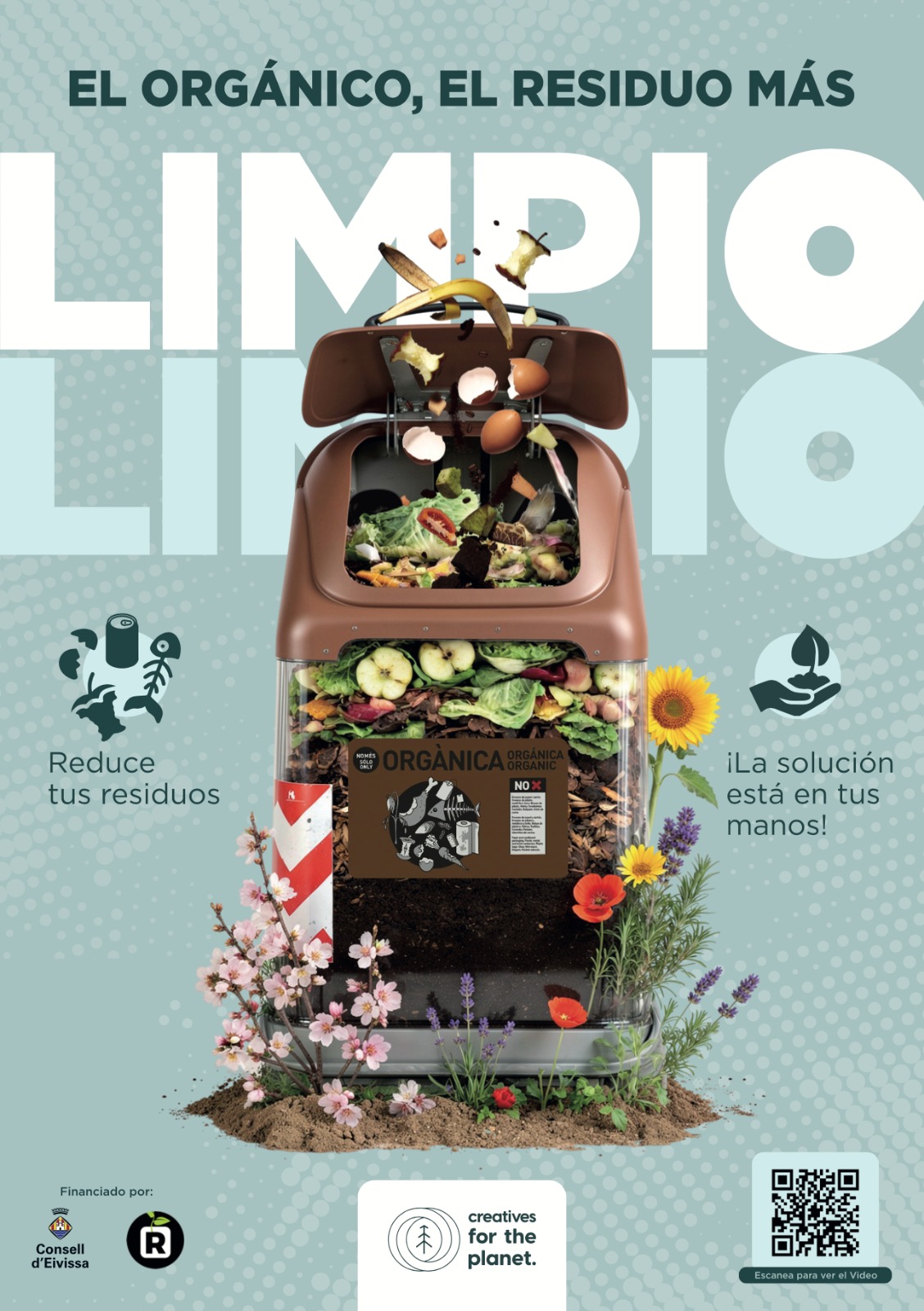
That’s why we, Creatives for the Planet, supported by the Consell Insular d’Eivissa, are launching L’orgànic, el residu més net (The organic – the cleanest waste) – an island-wide campaign to bring this story to every corner of Ibiza: schools, businesses, markets, community centres, and beyond. At its heart is a documentary filmed inside Ca Na Putxa, showing exactly what happens from collection to compost to clean energy. Because the most powerful thing we can do is make the invisible visible. The solution is in your hands.
www.creativesfortheplanet.org/organic
Text: Sophia Brucklacher
Thanks to Ibiza Live Report for publishing this article!